Automotive Sales Trends: What Brands Need To Know

Executive summary: Key automotive sales trends for 2025–2026
Global light-vehicle sales in 2025 have finally crossed the 2019 pre-pandemic threshold, reaching approximately 91–92 million units worldwide. This milestone marks the completion of a long recovery from COVID-19 disruptions, chip shortages, and logistics constraints that hammered the automotive industry for years. However, the celebration is short-lived. 2026 forecasts point to a flattening outlook, with demand fragmenting across regions, powertrains, and price points in ways that complicate planning for every player in the value chain.
The headline metrics tell a nuanced story. U.S. full year sales reached approximately 16.3 million units in 2025, but projections for 2026 show a dip to roughly 15.8–15.9 million, a decline driven by affordability pressures, tariffs, and incentive volatility. EV sales continue to grow globally, but with sharp month-to-month swings tied to government incentives and policy cliffs. Meanwhile, total vehicle sales remain concentrated in replacement-driven mature markets while growth engines shift to emerging economies.
This article is written for OEMs, dealers, distributors, and suppliers. The focus here is on how these automotive sales trends affect your product planning, pricing strategy, inventory allocation, and F&I operations. In the sections that follow, we’ll break down regional sales dynamics, electrification trajectories, margin and PVR trends, and the strategic moves needed to navigate a slower-growth, more complex market.
Global automotive sales outlook: Recovery plateau and regional divergence
Global light-vehicle sales in 2025 are forecast at approximately 91.7 million units, slightly above the 2019 peak of around 90 million. This represents a genuine milestone - the auto industry has finally recovered from years of supply chain chaos. However, expectations for 2026 are notably muted, with most estimates projecting only marginal growth in the range of 0–0.5%.
To put this in context, consider the trajectory: 2019 saw roughly 90 million global units, 2023 recovered to about 86 million, 2024 climbed to approximately 89 million, and 2025 reached the current 91.7 million figure. The post-pandemic rebound is now complete, but we’ve entered a plateau phase where auto sales growth will no longer come easily.
Growth is now concentrated in a handful of markets. India, parts of Southeast Asia, and select Latin American countries are recording strong demand, often in the high single digits year over year. Meanwhile, Europe, Japan, and North America have become largely mature, replacement-driven markets where consumers are holding onto vehicles longer—the average vehicle age in the U.S. now exceeds 12.5 years.
Macro drivers are reshaping the landscape:
- Interest rates: While expected to moderate from 7–8% to 5–6% APR in major markets, rates remain elevated compared to the near-zero environment that fueled pre-pandemic purchases
- Tariffs: Trade tensions have pushed material costs up 10–15% for steel and aluminum, with potential per-vehicle cost increases of $1,000–$2,000 depending on production location
- Supply constraints: Semiconductors and key materials remain tight, though not at crisis levels
For automotive businesses, the strategic implication is clear: planning on sustained high-single-digit volume growth is risky. The focus must shift to mix optimization across segments, powertrains, and trim levels, while building downstream revenue streams through service, software, and F&I to protect profitability when unit sales stall.
Regional sales trends: Europe, Asia, and North America in focus
Regional performance in 2025 is highly uneven, and businesses that apply a one-size-fits-all global strategy will struggle. Let’s examine the data from key markets to understand where opportunities and challenges lie.
France
French passenger vehicle registrations reached approximately 1.63 million units in 2025, still roughly one-fifth below the pre-COVID five-year average. Battery electric vehicles accounted for close to 20% of new registrations, supported by continued government incentives. The forecast calls for modest volume recovery in 2026, though affordability remains a constraint for mainstream buyers.
Germany
Europe’s largest market delivered about 2.8 million new cars in 2025, showing only 1–2% growth year over year. Weak GDP and depressed consumer confidence have kept buyers cautious. The impact of changing BEV subsidies has been particularly pronounced—many consumers delayed purchases in anticipation of incentive announcements, creating unpredictable demand patterns that complicate inventory planning.
Japan
Japanese sales recovered to around 4.6 million units in 2025 after production interruptions tied to the 2024 Daihatsu safety scandal. Mini-vehicles showed stronger growth than standard passenger cars, reflecting the market’s continued emphasis on fuel efficiency and compact dimensions. Hybrids remain dominant, with Toyota and other automakers maintaining strong positions in electrified vehicles that don’t require charging infrastructure.
Norway
Norway set a record high in 2025 with close to 180,000 registrations and world-leading BEV penetration exceeding 90% of new sales. However, a forecasted double-digit volume decline in 2026 looms as incentives step down and pull-ahead demand unwinds. This market offers a preview of what happens when subsidy-dependent demand meets policy cliffs.
UK
The United Kingdom achieved approximately 2 million registrations in 2025, marking a third consecutive year of growth but still falling short of historic peaks. BEV share reached the mid-20% range, with policy targets pushing toward one-third of sales by 2026. Fleet purchases remain a significant driver, though consumer demand softened in the second half.
United States
U.S. light-vehicle sales came in around 16.3–16.4 million units in 2025, modestly above 2024. However, 2026 forecasts pointing to 15.8–15.9 million units signal a slight contraction ahead. High transaction prices averaging near $48,000, tariff uncertainty, and the expiration of EV tax credits are all headwinds for dealers and OEMs alike.
What this means for businesses: These regional variations demand market-specific strategies. Flexible allocation of inventory, localized pricing, and tailored incentive approaches are essential. A production or pricing decision that works in one market may fail completely in another.
Electrification and powertrain mix: EV growth, policy cliffs, and hybrid resilience
BEV sales are still growing globally in 2025, but the pattern has become more volatile and policy-driven than ever. Sharp spikes and drops tied to subsidy and tax credit changes are now the norm, making demand forecasting a significant challenge for the entire automotive industry.
Consider the concrete patterns emerging across markets:
- Norway’s late-2025 surge: Buyers rushed to purchase electric vehicles ahead of 2026 incentive cuts, creating artificially inflated Q4 figures that will reverse sharply
- U.S. third quarter spike: BEV demand surged in August and September 2025 as buyers scrambled to capture the $7,500 federal tax credit before its expiration, followed by a steep decline that dragged EV share from 7.5% to a projected 6% for 2026
- Emerging market growth: South America and Asia-Pacific are recording near-40% year-over-year BEV growth, though from a low base that limits absolute volume impact
What’s particularly notable is the rise of hybrids as a bridge technology. Ford’s success illustrates this clearly—hybrid powertrains on models like the Maverick (deliveries up 18% to 155,000 units), Ranger, and Bronco Sport drove a 6% overall sales gain in 2025. Entry-level hybrid trims saw particularly strong demand, with combined sales rising 41% in Q4 2025.
Hybrids are forecasted to claim 34% of passenger vehicle sales by 2034, scaling to over 3 million units annually in the U.S. alone. For dealers and OEMs, this means:
- Stocking more hybrid inventory to meet strong demand from value-conscious consumers
- Reducing exposure to slow-moving BEV inventory as ev purchases decline without subsidies
- Positioning hybrids as “no compromise” options that deliver 40–50 MPG combined without range anxiety
Policy uncertainty around tariffs on battery imports, local content rules, and zero-emission vehicle mandates complicates long-term product planning. OEMs increasingly need flexible platforms that can support ICE, hybrid, and BEV variants from a common architecture.
For businesses across the value chain, monetization opportunities around EV ownership remain significant: home and public charging services, energy tariffs, digital service subscriptions, and extended warranties on battery packs all represent incremental revenue streams worth developing.
U.S. automotive sales trends: Monthly volatility, tariffs, and EV demand shifts
The 2025 U.S. sales headline of 16.3–16.4 million units and modest 2–3% year over year growth masks significant intra-year volatility. For dealers and OEMs, understanding these swings is essential for informed decisions about inventory, pricing, and production planning.
Key 2025 inflection points
The year played out in distinct phases:
- March–April rush buying: The announcement of 25% import tariffs triggered a surge in purchases as consumers and dealers alike tried to beat price increases. This pull-forward demand boosted first half figures but created a hangover effect later in the year.
- Strong summer months: Trucks and SUVs—particularly hybrid variants—performed well through June and July, with higher inventory levels allowing dealers to meet demand that had been constrained in prior years.
- August–September EV spike: The approaching federal tax credit expiration drove a significant pull-forward in EV demand, with some markets seeing double-digit month-over-month increases in battery electric vehicles.
- Softer fourth quarter: The combination of tariff-related price increases, credit expiration, and general affordability concerns led to slowing demand in the final quarter, with sales figures coming in below expectations.
Mix trends reshaping the market
Light trucks continue to gain share through 2025, now accounting for well over 75% of new vehicle sales in the U.S. Passenger cars keep declining at mid-single to double-digit rates year over year. This shift has major implications:
- Factory capacity utilization is increasingly weighted toward truck and SUV platforms
- Dealer floorplan strategies must account for higher per-unit costs on larger vehicles
- Light commercial vehicles are becoming a larger portion of the mix
Tariff and supply disruptions
Multiple waves of tariffs on Mexican, Canadian, and Asian imports forced continual adjustments throughout 2025. Supply issues—including lingering semiconductor shortages and aluminum disruptions—added further complexity. Dealers report that aggressive inventory clear-outs dumped over 100,000 units in recent two-week surges as manufacturers made room for new model years.
Business implications: The 2025 experience demonstrates the need for:
- More dynamic inventory management systems
- Real-time pricing tools that can respond to market shifts
- Data-driven allocation decisions that maximize gross and turn rates
- Scenario planning for continued tariff and policy volatility
Looking to 2026, forecasts around 15.8–15.9 million units suggest a mild volume step-down that will heighten competition for share and increase pressure on margins across new, used, and CPO segments. The days of “build it and they will come” are over.
Dealer and OEM profitability: PVR, F&I performance, and margin compression
While volumes improved in 2025, front-end margins on new vehicles compressed as inventory normalized. Days-to-turn metrics, which had dropped to historic lows during supply shortages, have stabilized around 50–60 days in most markets. This normalization pushed dealerships and OEMs to rely more heavily on F&I and downstream revenues to maintain profitability.
F&I as a profit center
F&I profit per vehicle retailed (PVR) in the U.S. finished 2025 at its strongest level since approximately Q3 2022. This occurred even as front-end PVR softened through mid-year before stabilizing by late summer and early fall. The lesson is clear: F&I isn’t optional anymore—it’s essential.
Several factors are driving F&I performance:

Product penetration trends
The data shows modest year over year increases in vehicle service contract uptake through 2025. GAP insurance sales recovered after mid-year declines, driven by consumers recognizing the risk of being upside-down on high-value loans. Maintenance plans and tire-and-wheel packages also showed resilience.
For dealers, the key opportunity lies in professionalizing F&I operations:
- Rigorous training: Product knowledge and compliant presentation techniques
- Menu selling: Systematic, transparent presentation of all available products
- Underwriting discipline: Careful reserve monitoring and risk management
- Customer experience focus: F&I should enhance, not detract from, the purchase process
Strategic takeaway
Dealers and OEM-affiliated finance companies must treat F&I and lifecycle services as core profit centers, not afterthoughts. In a slower-growing unit sales environment, the business that optimizes products per deal and service retention will outperform competitors still focused primarily on moving metal.
Strategic implications for automotive businesses: How to respond to 2025–2026 sales trends
The 2025–2026 period is less about volume expansion and more about adaptability, mix management, and new revenue models. For all players in the automotive ecosystem—from manufacturers to retailers to suppliers—the rules of the game are changing.
Priorities for OEMs
Manufacturers navigating this environment should focus on:
- Flexible platforms: Develop architectures that can support ICE, hybrid, and BEV variants without massive retooling, allowing production to shift based on demand signals
- Localized production: Mitigate tariff exposure by reshoring or near-shoring critical manufacturing, particularly for North American sales
- Software-defined vehicle roadmaps: Build technology stacks that enable over-the-air updates, predictive maintenance, and subscription services
- Charging and mobility partnerships: Collaborate on infrastructure development to remove barriers to EV adoption without bearing full capital costs
- Mix optimization: Prioritize high-margin segments (hybrids, entry-level trims on popular models) over volume-at-any-cost approaches
Priorities for dealers and national sales companies
Retail operations should emphasize:
- Granular demand forecasting: Move beyond historical averages to predictive models that account for policy changes, regional variations, and economic indicators
- Agile inventory and pricing tools: Implement systems that allow rapid adjustment of prices, incentives, and allocation based on real-time market data
- F&I reinforcement: Train staff, implement compliant menu selling, and track penetration rates as key performance indicators
- Used-vehicle and CPO strength: Develop robust used and certified pre-owned operations to buffer new-car volatility—off-lease returns are expected to surge by around 400,000 units in 2026
- Service retention: Invest in service lane capacity and customer retention programs that generate recurring revenue
The data advantage
Businesses that leverage telematics, connected car data, and integrated DMS/CRM insights will gain a significant edge. Rather than reacting to sales swings after they occur, leading companies will:
- Anticipate churn and proactively address customer concerns
- Identify service needs before vehicles arrive at the dealership
- Personalize financing offers based on individual credit and preference data
- Optimize conquest and retention campaigns with precision targeting
The path forward
The automotive businesses that thrive in 2025–2026 will be those that reorient from “selling units” to “managing customers and vehicles over their full lifecycle.” This means thinking beyond the transaction to the ongoing relationship—from acquisition through service, trade-in, and repeat purchase.
The market isn’t collapsing, but it isn’t booming either. What we’re seeing is a maturation of demand combined with unprecedented complexity in policy, technology, and consumer preferences. Businesses that embrace this reality—building flexibility into their operations, investing in downstream revenue, and making data-driven decisions—will be best positioned to capture share and protect profitability amid fragmented growth and fast-changing automotive sales trends.
The companies that continue operating as if volume growth will solve all problems will find themselves increasingly squeezed. The choice is clear: adapt now or struggle later.
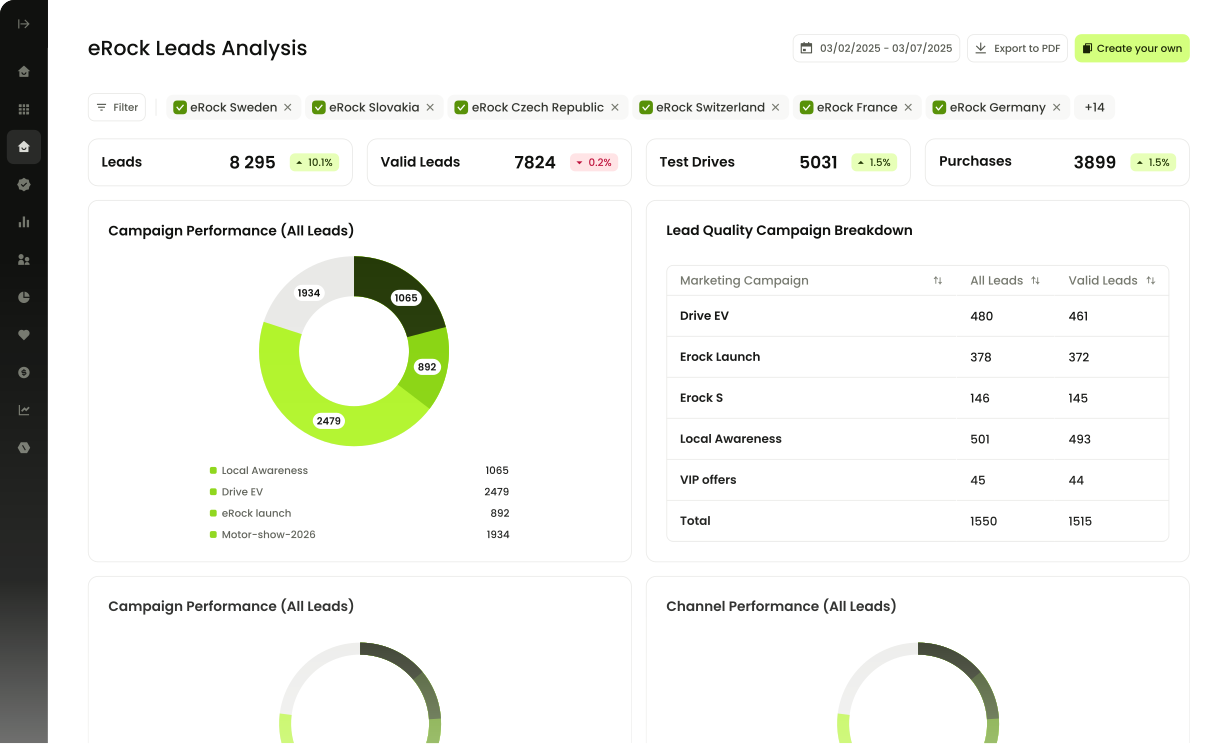
Ready to transform your automotive lead generation? Driftrock powers lead generation for 65% of the automotive industry, helping 80+ brands across 24 markets generate over 1.7 million leads annually and enable £1.8 billion in vehicle sales. Our platform automatically validates leads, routes them to the right dealers, and tracks performance from click to sale, saving marketing teams an average of 3 years and 11 months in time whilst cutting costs by up to 50%.
Whether you're looking to increase lead volume, improve conversion rates, or prove ROI, we've built the tools automotive marketers actually need. Book a demo to see how we can help you drive better results from your marketing spend.