

Automotive email marketing is how car brands, importers and retailers use email to turn enquiries into test drives and sales, then keep owners loyal. The best performing emails, though, are the ones triggered by a buyer’s action, such as a test drive request.
It is 9 pm on a Tuesday. A buyer has spent the evening comparing family SUVs and fills in a test drive form on their phone. Over the next few weeks, a handful of emails will decide whether that enquiry becomes a sale, a lost lead or a sale for a competitor.
Most conversations about automotive email marketing start with the newsletter: model news, seasonal offers, launch teasers. Those emails have their place, but the bigger opportunity sits a step earlier, in the emails a buyer is actually waiting for.
This guide follows that one enquiry from the moment it arrives to the day the car is handed over. Along the way, it looks at what the data says works, what needs to be true before any email is sent, and how to measure whether email is really selling cars.
Which automotive emails perform best?
The best-performing automotive emails are the ones a buyer expects. In UK retail data from the second half of 2025, post handover emails averaged an 80% open rate and enquiry follow ups 65%, far above general campaign benchmarks of around 21%.
Our buyer is now watching their inbox. That changes everything about how the next email performs, because they are expecting it.
The UK data shows how big that effect is. Marketing Delivery analysed around 4.5 million emails sent by more than 500 UK franchised retail businesses in the second half of 2025. Messages tied to something the customer had just done, or was about to do, were opened by most recipients:
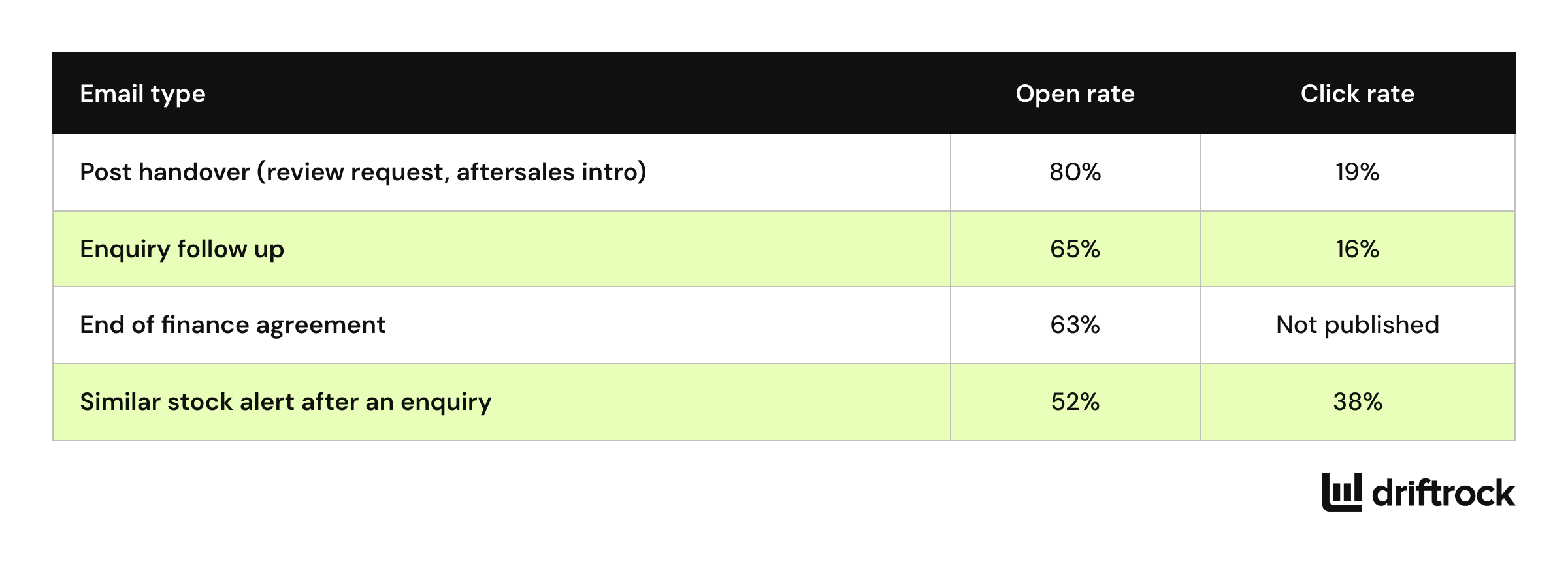
Source: AM Online, reporting Marketing Delivery's H2 2025 analysis
Compare that with general marketing email. Brevo's 2026 benchmark of more than 175,000 senders puts the average campaign open rate at 20.73%, and 20.15% for its manufacturing, automotive and construction category. The datasets differ, so treat the comparison as directional, but the message is consistent: relevance and timing beat volume.
There is a catch, though. The same Marketing Delivery analysis found 9% of customer records had no email address and 7% had no mobile number. An enquiry follow up that opens at 65% is worth nothing if it never arrives, which is why the first job is not writing the email at all.
How lead quality affects automotive email marketing
Automotive email only works if the lead is valid, unique and ready to hear from a retailer. That is why validation, deduplication and qualification should all happen before the first email is sent.
In the seconds after our buyer presses submit, three questions decide whether any email can work: are the contact details real, is this the only enquiry from this person, and are they ready to hear from a retailer?
Are the details real? Lead ads and quick forms make enquiring effortless, which is great for volume. As with any high volume channel, some entries will include typos or details that can’t be reached, so checking them at the point of capture keeps quality high. Across Driftrock customers, around 10% of leads are rejected on average as invalid before they reach the CRM. Without that check, those leads still get emails that bounce, damage sender reputation and waste a salesperson's time. When BMW Motorrad Thailand introduced Driftrock Lead Validation, contactable leads rose by 16%.
Is it a duplicate? Our buyer may have enquired through a lead ad on Monday, a publisher site on Tuesday and the brand website the same evening. Without deduplication across sources, they get three welcome emails and three calls from different people, which makes trust harder to build at exactly the moment it matters most.
Are they ready? Some buyers are months away, some want finance information first, and some never meant to request a callback. Driftrock Convert starts a short, structured conversation over email, WhatsApp or SMS the moment a lead arrives, confirming intent, timeline, model interest and decision stage. Warm, verified prospects go straight to the retailer network, while everyone else moves into nurture. (Driftrock Convert)
Validation also points to the right channel. A valid email but no valid mobile number suggests leading with email; a valid mobile but a doubtful email suggests WhatsApp or SMS first. With a real, unique, qualified lead in hand, the clock is now running.
See how Driftrock checks every lead before it reaches your CRM
How fast should you respond to a car enquiry?
Send an automated confirmation within seconds of an enquiry and a personal follow up within the hour. In the 2025 Pied Piper study of US dealer groups, the top performers answered 90% of customer questions within an hour.
Our buyer's interest will never be higher than it is right now. In the 2025 Pied Piper Internet Lead Effectiveness study of US dealer groups, the top performers answered 90% of customer questions by email or text within an hour and followed up by phone 96% of the time. The study also found a 50 point gap between the best and worst groups. (WardsAuto) The data is from the US, but the principle travels globally.
Speed matters, but so does what comes next. The strongest follow up pairs the reassurance of an instant reply with a real person the buyer can talk to.
The pattern that works has two steps:
- An instant automated email, within seconds, that confirms the request and delivers what was asked for: the brochure, the price, the test drive details.
- A personal follow-up from the named salesperson who now owns the lead, which the buyer can simply reply to.
For a buyer who is ready, those two emails lead straight to a test drive. But not every buyer is ready to book.
How to segment and nurture car buyers who are not ready
Buyers who are not ready to book should be segmented by lifecycle stage and moved into triggered nurture sequences.
Suppose our buyer replies that they are still comparing two models and will not decide for a couple of months. They have not gone cold; they are simply at a different stage. Treating them like a ready buyer pushes them away, and treating them as a general marketing contact misses what they’ve already told you.
That is why automotive segmentation should start with lifecycle stage, then layer on model, powertrain, market and consent:
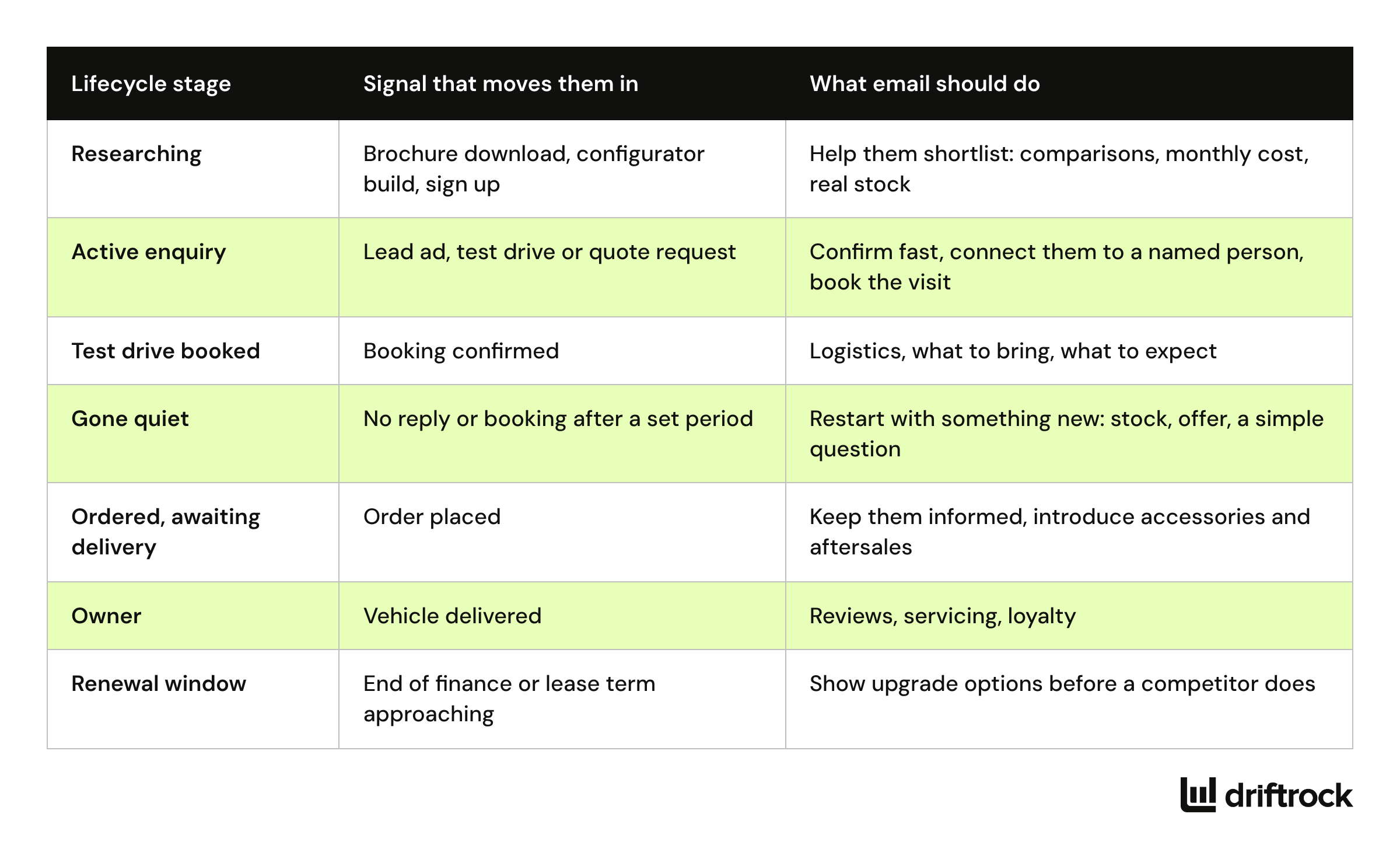
Our buyer sits in "Active enquiry" moving towards "Researching", and this is where nurture earns its place. Triggered emails consistently outperform scheduled ones: in Brevo's 2026 benchmark, automated and transactional emails averaged a 30.63% open rate and 7.39% click rate, against 20.73% and 2.27% for standard campaigns. (Brevo)
A simple nurture sequence for our buyer might look like this. The timings are a starting point to test, not a benchmark:
- Day 0: instant confirmation with what they asked for.
- Day 1: personal note from the assigned salesperson.
- Day 3: content for the two models they are weighing, such as a comparison or a monthly cost example.
- Day 7: similar stock or a relevant offer at their nearest retailer.
- Day 14: a short, plain text check-in asking one question, such as "Are you still deciding between the two?"
Three rules keep it helpful. First, exit on action: the moment the buyer books, replies or buys, they leave the sequence. Second, keep pushing towards the test drive; Bain found consumers who have test driven a battery electric vehicle are up to 2.2 times as willing to consider buying one. (Bain via PR Newswire) Third, coordinate channels, so a WhatsApp nudge and an email feel like one conversation rather than two.
The same lifecycle thinking runs all the way to the renewal window. Marketing Delivery's H2 2025 data showed end of finance emails averaging a 63% open rate, up 12% on the first half of the year, so the buyer who signs this year could be a warm lead again in a few years. Getting there, though, depends on what happens once the retailer takes over.
Qualify buyers before they reach your retailers. Get in Touch.
How can brands and dealers collaborate on automotive email marketing?
The brand is best placed to send the instant confirmation and assets such as brochures. Retailers and dealers are best placed to own the personal follow up, appointments, stock alerts and ownership emails.
Two months later, our buyer is ready. From here, the emails that matter most often come from the retailer, and the UK data shows they are some of the best performing emails in the industry.
The split that works is simple: the brand confirms and informs, the retailer builds the relationship. Retailers are closest to the buyer for:
- The personal follow up: once a lead is assigned, the next email comes from a named person at the retailer.
- Appointments and logistics: test drive confirmations, reminders and handover details depend on the location, the stock and the person the buyer will meet.
- Stock alerts: retailers know what is on the forecourt. In Marketing Delivery’s H2 2025 data, emails showing vehicles similar to one a customer enquired about averaged a 38% click rate.
- Ownership: post handover emails averaged an 80% open rate in the same data. Reviews, servicing and, eventually, the renewal window all start here. (AM Online)
The strongest programmes treat this as one journey. When brand and retailer agree who sends what, and when, the buyer experiences one joined up conversation. Shared data helps too: when both capture and check an email address and mobile number at every touchpoint, every email in the journey has a better chance of landing.
How much of the sale happens in the showroom, and how much in the inbox, also depends heavily on where in Europe our buyer lives.
How automotive email marketing differs across Europe
Across Europe, buyers research online but still mostly buy in person. Bain's 2026 Global Automotive Consumer Survey of more than 12,000 buyers found that over 80% combine online and offline channels, nine in ten still complete the purchase offline, and more than half of European buyers interact with a dealer at least twice along the way. Price is the top consideration for 62% of European buyers. (Bain via PR Newswire)
That makes email the bridge between online research and the showroom, but the bridge needs building differently in each market. Codeweavers' 2026 survey of 5,000 buyers across five markets shows how much expectations vary:
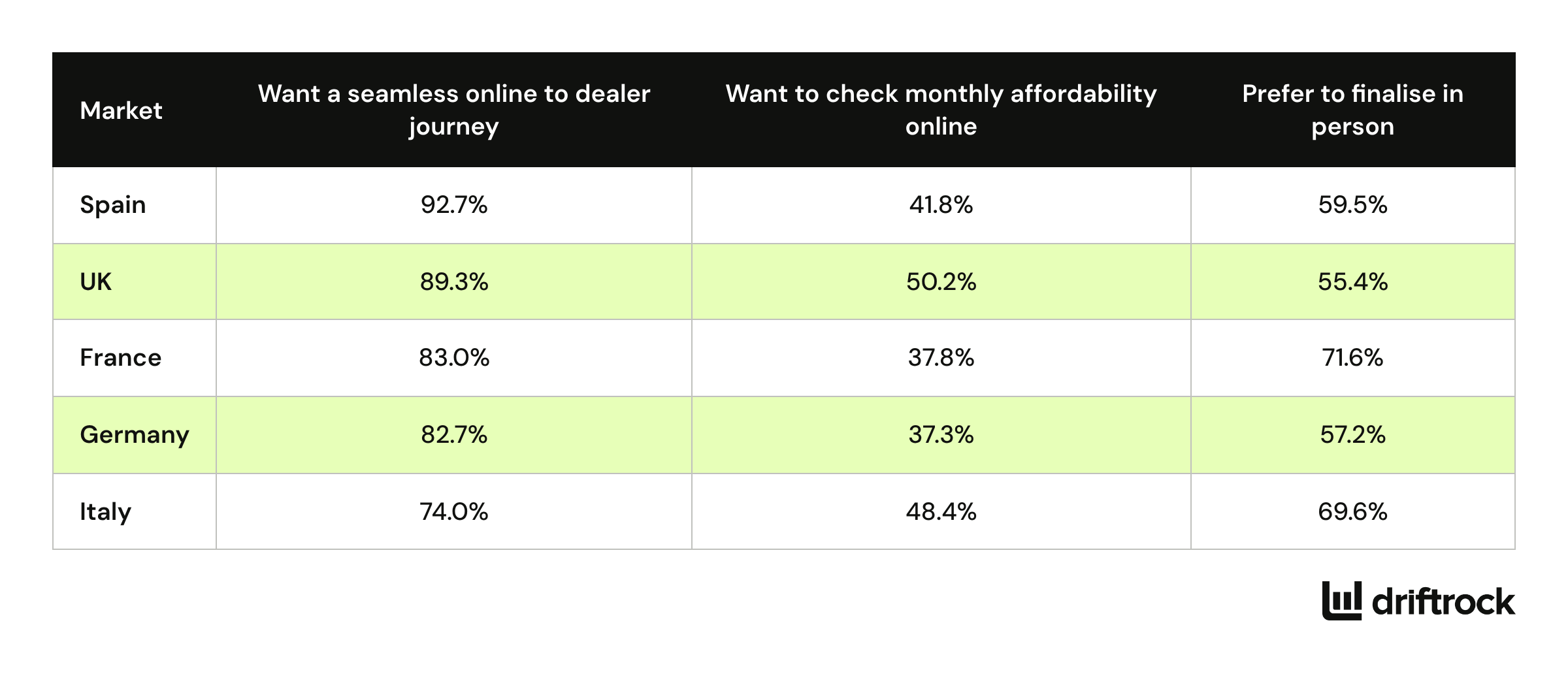
Source: Codeweavers, UK vs European car buying trends 2026
If our buyer is in France or Italy, where around 70% prefer to finalise in person, the email's main job is to get them to the dealer. In the UK or Germany, email can carry more of the selling. Wherever they are, a few things hold:
- Show monthly cost: A monthly payment calculator was the most wanted online step in every market surveyed, so link to one from enquiry follow ups.
- Do not make buyers repeat themselves: One in five UK buyers (20.7%) are frustrated by having to give the same information again across channels. Emails should carry the model, specification and retailer they already chose.
- Localise, do not just translate: Codeweavers describes France as more traditional and dealership led, and Germany as financially mature and digitally engaged. Tone and calls to action should reflect that.
The good news is that Europe's inbox is a relatively friendly place. Brevo's 2026 benchmark puts Europe's average open rate at 22.83% and click rate at 2.29%, the highest of any region, and Validity's 2025 data shows 89.1% of European email landing in the inbox. (Brevo) Reaching the inbox is only half the job, though. The email still has to be opened and used.
Subject lines, sender names and email design for car buyers
Automotive emails get opened and used when the subject line confirms what the buyer asked for, the sender is a named person, and the layout works on a phone first.
Every email our buyer receives competes with everything else in their inbox, usually on a small screen. Three details make the difference: the subject line, the sender and the layout.
The subject line should confirm, not tease.
For an enquiry email, the best subject line tells the buyer they are getting what they asked for. "Your {model} test drive on Saturday" beats "Thanks for your enquiry". Brevo recommends staying under 50 characters so the full line shows on mobile, and treating the preview text as a second subject line rather than leaving it as "View this email in your browser". (Brevo)
For retailer emails, the sender should be a person where possible.
In an A/B test across its US dealer clients, agency 9 Clouds found emails from "Dave at Car Dealership" were opened more than those from just the person's name or just the dealership. The study dates from 2019, so test it in your own market. (9 Clouds)
Here is how that might look across the journey, using fields captured with the lead:
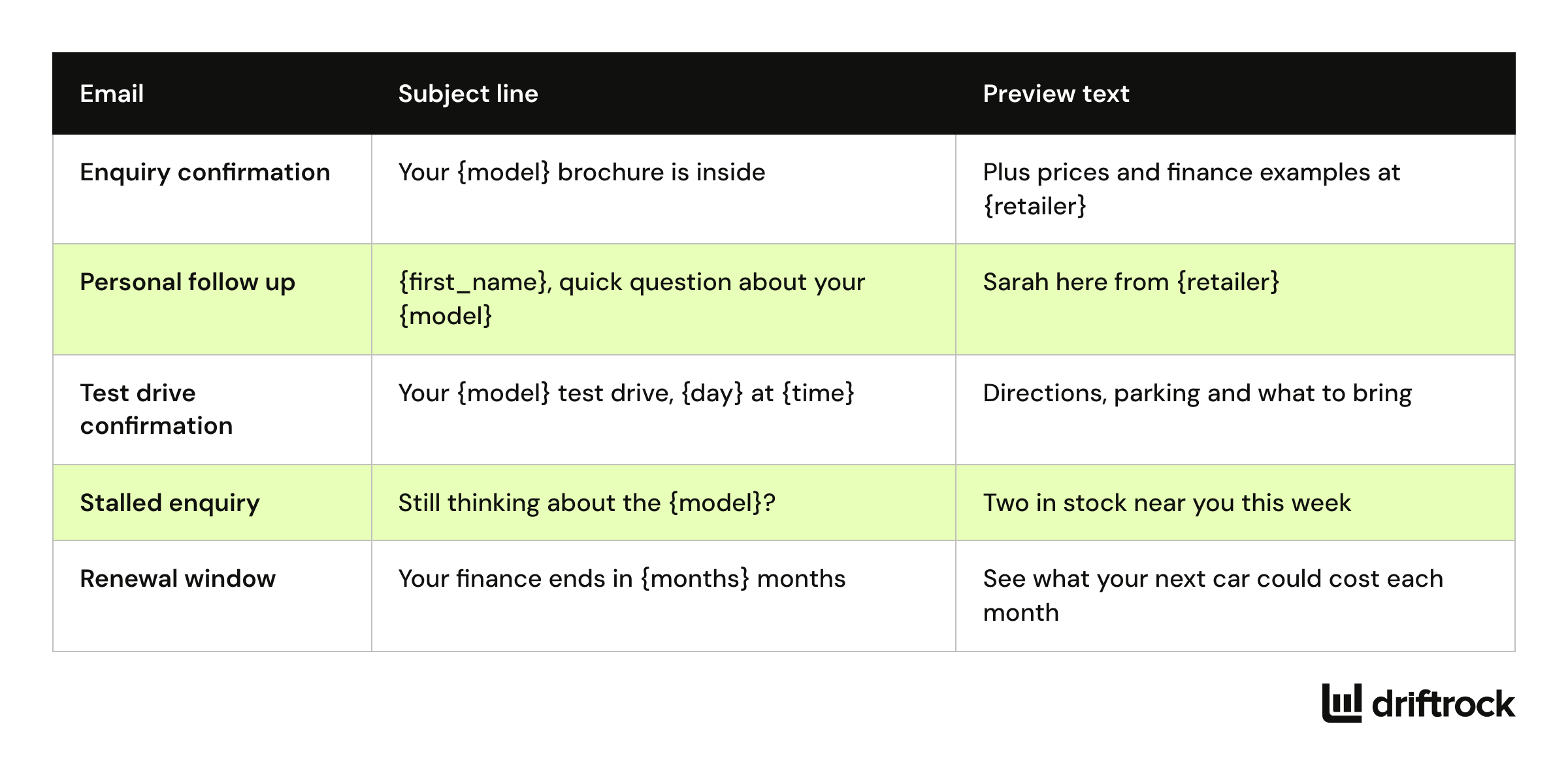
The layout should work on a phone first.
Brevo notes that nearly half of all emails are opened on mobile, so:
- Use one column and one main action: such as "Book my test drive", placed near the top.
- Make buttons easy to tap: Brevo recommends buttons at least 44px tall, and 9 Clouds found buttons were the most clicked link type in automotive emails, at 59% of top clicked links.
- Use live text, not text inside images: so price, date and retailer address still show when images are blocked.
- Add one tap actions: call the retailer, open a map, add the test drive to a calendar.
- Check dark mode: where dark logos on transparent backgrounds can disappear.
Desktop still matters for the deeper research. Configurators, finance comparisons and spec sheets are often explored on a bigger screen, so link to them rather than cramming everything into the email, and make sure every link opens exactly what the email promised, not the brand homepage.
The six emails every automotive brand needs
Every automotive email programme needs six triggered emails: an enquiry confirmation, a personal follow up, a test drive confirmation, a stalled enquiry follow up, a similar stock alert and a post handover email.
Looking back over our buyer's journey, six emails did most of the work. Newsletters have their place, but these six are the foundation, and each needs a real trigger behind it.
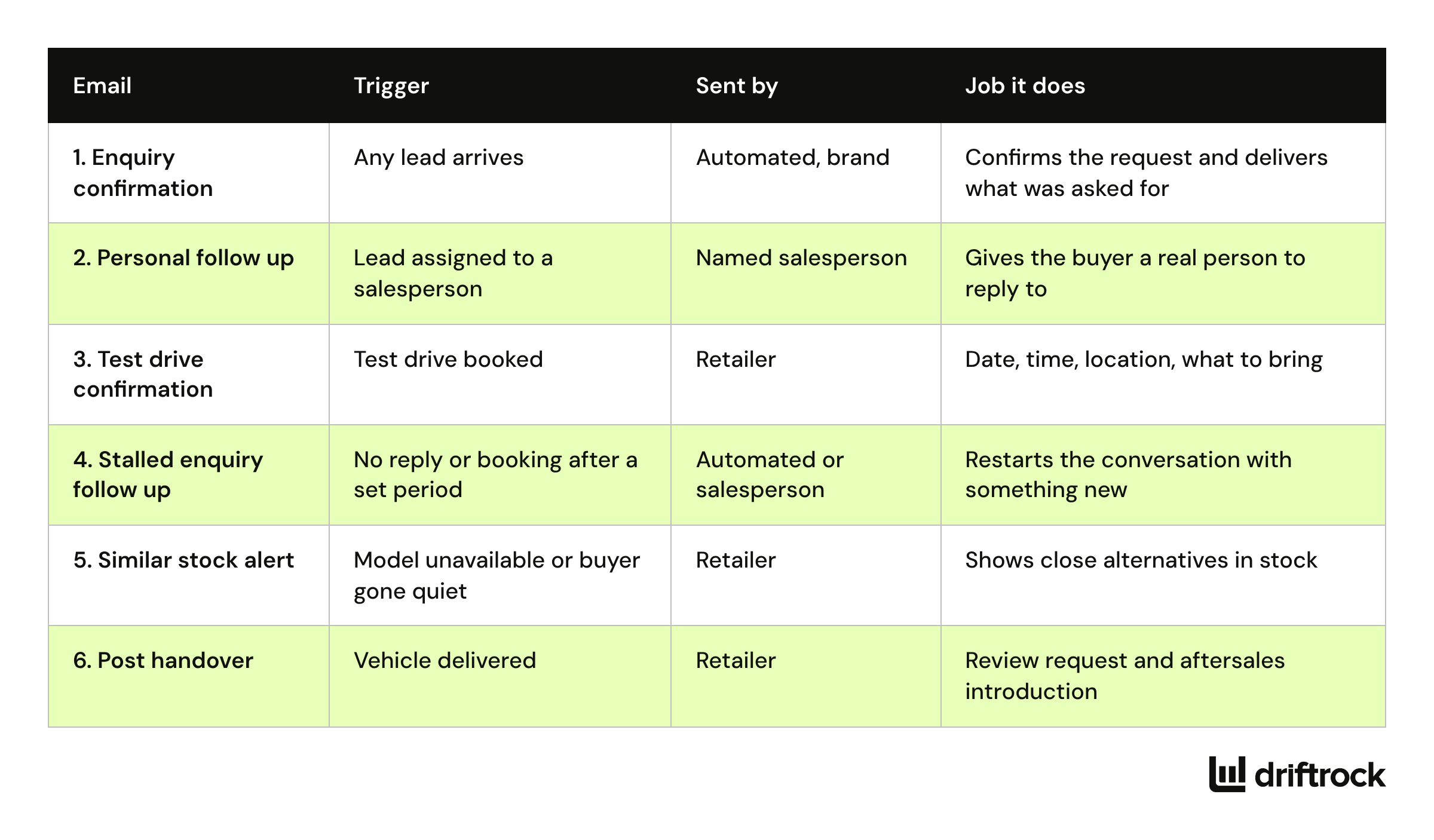
Whether these six are actually working is a different question, and open rates will not answer it.
Which automotive email metrics matter most?
The automotive email metrics that matter most are test drive booking rate and lead to sale rate. Open rates are useful for trends, but Apple's Mail Privacy Protection inflates them.
If our buyer uses Apple Mail with Mail Privacy Protection switched on, every email they receive counts as opened, whether they read it or not. Brevo's 2026 benchmark shows the size of the distortion: the average open rate is 20.73% without these automatic opens and 33.87% with them. (Brevo) Open rate is still useful for spotting trends, but decisions should rest on what happens after the open.
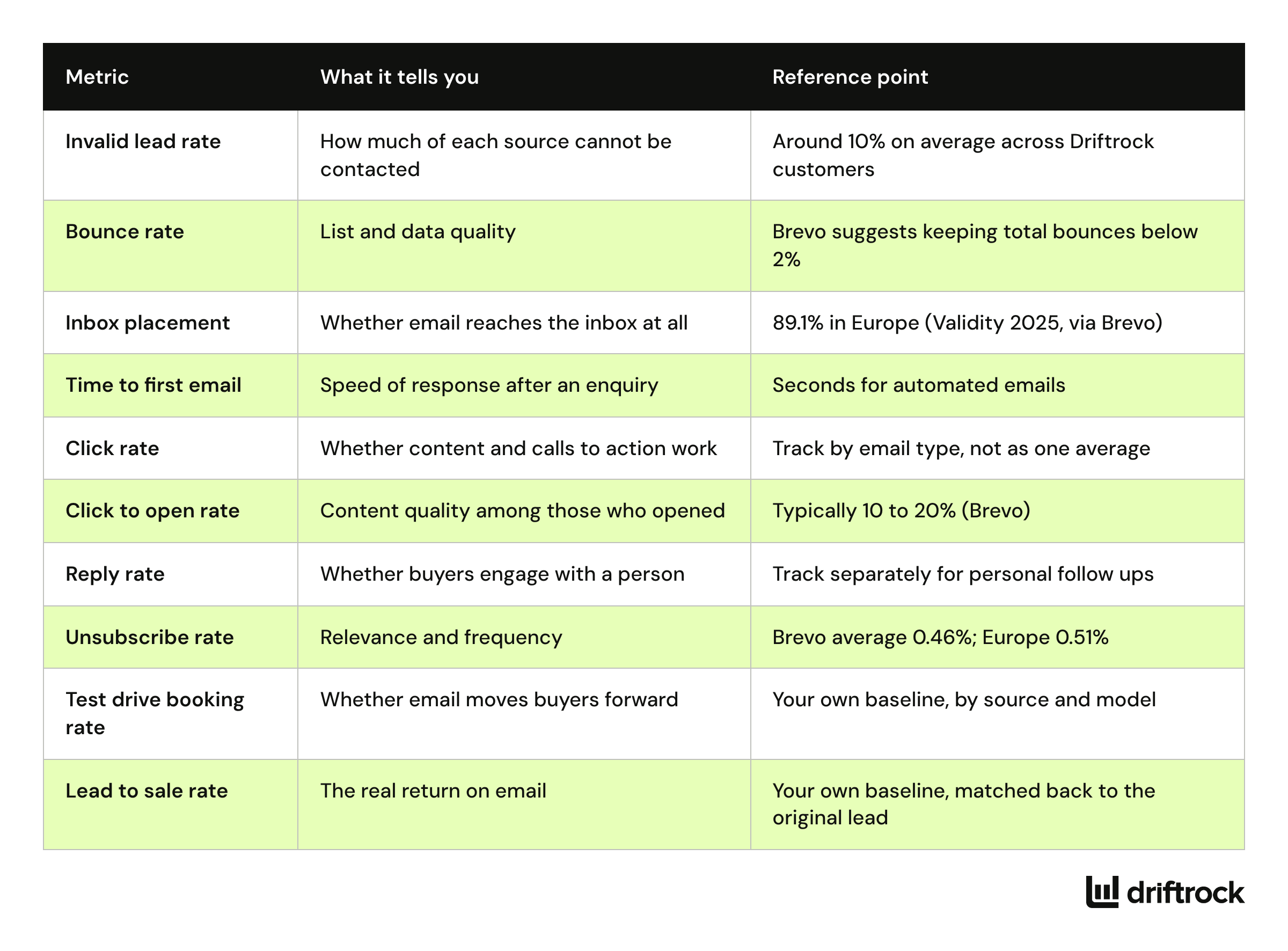
The last two rows matter most, and they are the hardest to get. Answering "did that nurture sequence sell our buyer a car?" means connecting the original lead, the CRM and the sale, then reporting by source, model and market. That connection is exactly where Driftrock comes in.
Get in Touch to Track every enquiry through to vehicle sales.
How Driftrock supports every step of the journey
Driftrock sits between every lead source and every system that acts on a lead, so it can automate each step of our buyer's journey and measure it.
- When the lead arrives, real-time Lead Validation checks email, phone, and address, and deduplication catches duplicates across sources before anything is sent.
- In the first seconds, Auto Responders send a personalised confirmation from any capture, whether a lead ad, website form, publisher form or event. Dynamic fields drop in the model and test drive time, and routing rules decide who gets which version, for example, a dedicated email for buyers interested in electric.
- When the buyer replies, Auto Responders can set the Reply To address to the salesperson who handled the lead, so the reply reaches a person rather than a shared mailbox.
- When the buyer is not ready, Driftrock Convert qualifies them through conversations over email, WhatsApp and SMS, and routes only warm prospects to retailers.
- At handover, automatic dealer assignment routes each lead to the nearest retailer by postcode, and Driftrock Inbox gives retailer teams one view of the email and WhatsApp conversation so far.
- Across your email stack, leads flow in real time to platforms including Salesforce Marketing Cloud, Braze, Dotdigital, Oracle Eloqua, Klaviyo, Mailchimp and Campaign Monitor, and to CRMs such as Salesforce, Microsoft Dynamics 365 and HubSpot.
- All the way to the sale, downstream tracking matches leads to test drives and vehicle sales, so email can be judged on cars sold, not opens.
Driftrock powers lead generation for 35+ automotive brands across 32 markets, processing more than 2.3 million leads a year and enabling over £3 billion in vehicle sales.
Where does your programme stand?
Think back to our buyer at 9 pm on that Tuesday. If you can answer yes to all seven questions below, they would get a fast, personal and measurable experience from your brand:
- Does every lead source trigger a confirmation email within seconds?
- Does that email deliver what the buyer asked for, not just a thank you?
- Can the buyer reply and reach a named person?
- Is each lead routed to the right retailer before the personal follow up?
- Are invalid emails and phone numbers caught before they reach the CRM?
- Do nurture sequences stop as soon as the buyer books or buys?
- Can you trace email follow up through to test drives and vehicle sales?
Any "no" is where to start. Book a demo to see how Driftrock turns every enquiry into a fast, personal and measurable follow up.
FAQ
What is automotive email marketing? It is the use of email by car brands, importers and retailers to engage buyers and owners across the journey: enquiry follow up, test drive confirmations, offers, finance renewals and aftersales. The best performing emails are triggered by something the customer has just done.
What is a good open rate for automotive emails? It depends on the email type. In Marketing Delivery's H2 2025 UK data, enquiry follow up emails averaged a 65% open rate and post handover emails 80%. General marketing campaigns sit much lower: Brevo's 2026 benchmark puts the average at 20.73%, or 22.83% in Europe. Bear in mind that Apple's Mail Privacy Protection inflates open rates.
How quickly should a car brand or retailer respond to an online enquiry? As fast as possible. An automated confirmation should go out within seconds. In the 2025 Pied Piper study of US dealer groups, the top performers answered 90% of customer questions by email or text within an hour.
Should OEMs or dealers send the follow up email? Both, with clear roles. The brand is best placed to send the instant confirmation and deliver assets like brochures. The retailer, ideally a named salesperson, should own the personal follow up and everything after.
Does automotive email marketing differ across Europe? Yes. Codeweavers' 2026 survey found around 70% of buyers in France and Italy prefer to finalise their purchase in person, compared with 55.4% in the UK. Emails in more dealership led markets should focus on getting the buyer to the showroom.
How do you stop follow up emails bouncing? Validate email addresses at the point of capture and block invalid leads before they reach the CRM or email platform.