
.svg)
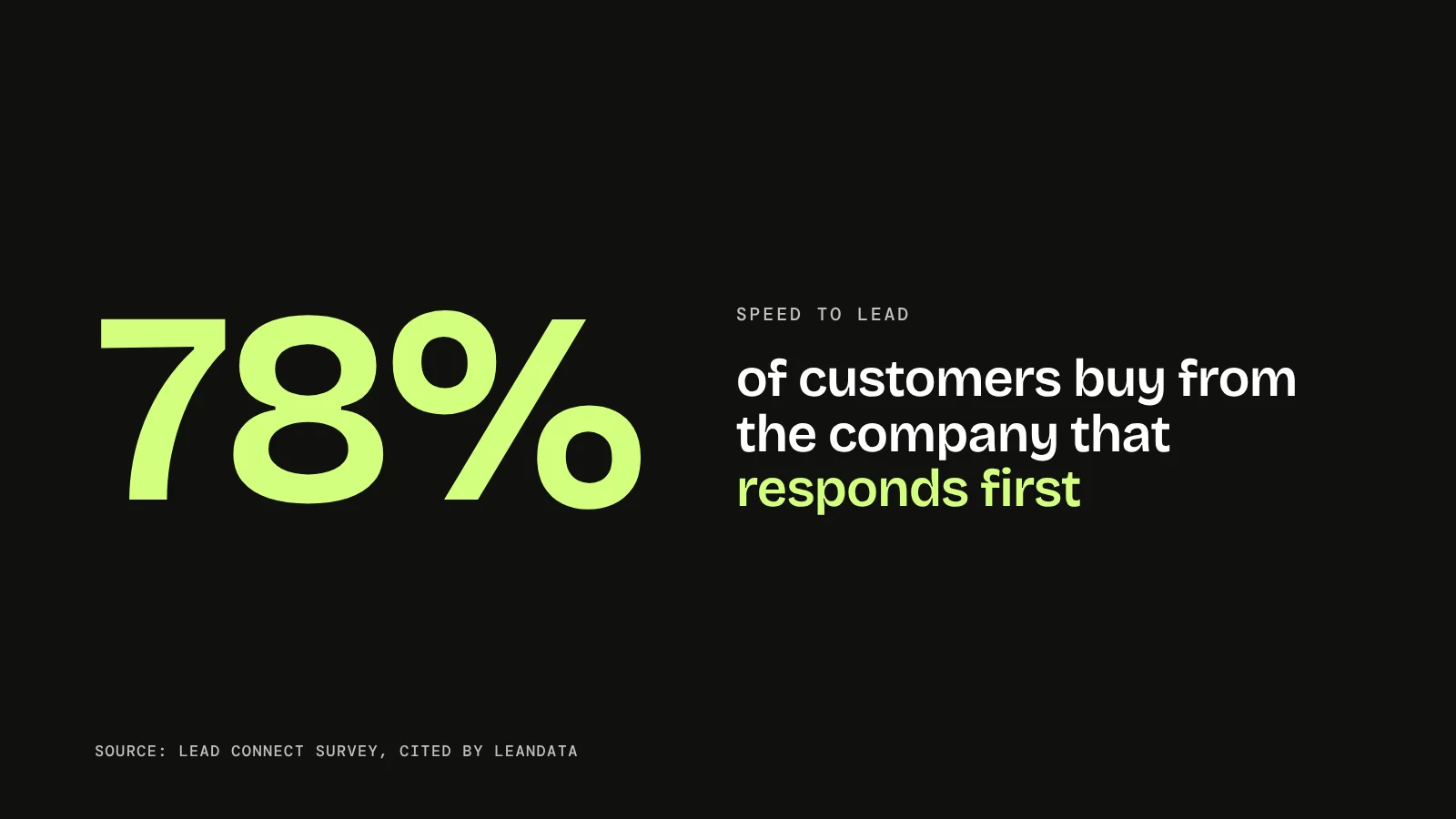
Automotive marketing has a leaky bucket problem. Brands spend more than ever generating demand, yet a huge share of the leads they pay for never turn into customer conversations, let alone vehicle sales. Research from Lead Connect found that 78% of customers buy from the company that responds first, yet the average dealership takes 47 hours to respond to a new lead, and 71% of automotive leads never receive any follow-up at all.
For an industry where the average new car buyer spends more than 13 and a half hours researching and shopping before purchase, that gap between buyer intent and seller response is where sales are lost.
This is the problem automotive lead management software exists to solve. In this guide, we will cover what an automotive lead management system actually does, the lead management processes behind it, the features that matter, and how OEMs, dealerships, and their agencies use lead management software to convert more of the leads they already generate.
So what does effective lead management look like in practice? Let's dive in.
What is automotive lead management software?
Automotive lead management software is a platform that captures leads from every marketing channel, validates and qualifies them, routes them to the right sales team or dealer, nurtures them through the customer journey, and measures which marketing campaigns actually produce vehicle sales.
Think of it as the central nervous system of your customer acquisition: every enquiry, from a Facebook lead form to a test drive booking on a publisher site, flows through one lead management system where it can be checked, enriched, prioritised, and acted on. Whether you call it auto lead management, dealer lead management, or an automotive lead management system, the job is the same: stop leads leaking between marketing and sales.
That is different from a generic CRM system. Customer relationship management platforms are built to store customer relationships and manage the sales pipeline. Lead management software sits upstream: it manages how leads are captured, cleaned, and delivered into the CRM in the first place, then closes the loop by feeding conversion data back to the ad platforms.
A good automotive lead management system handles four jobs, each unpacked in the process section below: lead capture from paid social, search, your website, publishers, events, and third-party lead providers; validation and lead qualification, so junk contact details never reach your sales team; routing and nurturing; and measurement, connecting leads to test drives and vehicle sales.
The automotive lead management software category is growing fast. Dataintelo values the global automotive lead management software market at $5.2 billion in 2025, reaching to $12.8 billion by 2034, at 10.5% CAGR, driven by digital retailing and the shift to first-party data.
Why automotive lead management is harder than it looks
Every industry struggles with lead follow-up, but automotive lead management has a distinct set of challenges, because automotive sales cycles are long, considered, and fought over.
Buyers shop multiple brands and retailers at once. A typical in-market car buyer enquires with several dealerships and brands simultaneously, which makes lead response time a competitive advantage in its own right, not an operational detail. For internet leads especially, minutes matter.
Leads arrive from everywhere. Meta, Google, TikTok, YouTube, publisher sites, car configurators, events, chatbots, phone calls, walk-ins. Without a lead management system, each channel becomes its own spreadsheet, inbox, or CSV export. Lead leakage is inevitable, and manual data entry introduces errors and delays.
Not all leads are ready to buy. Some enquirers want a test drive this week; others are six months from purchase. Treating them the same wastes your sales team's time on browsers and under-serves genuine buyers. Not all leads deserve the same follow-up, so a one-size-fits-all sales process fails both groups. Knowing the difference requires lead scoring and qualification data, not gut feel.
The funnel spans online and offline. A lead captured online converts in a showroom weeks later. If that offline outcome never flows back to your marketing channels, you cannot optimise advertising spend towards the campaigns that actually sell vehicles. You are flying blind on lead quality.
Long gaps between purchases. A customer might buy once every three to five years. Between purchases, customer relationships have to be maintained through service, finance renewals, and lifecycle marketing, or you start customer acquisition from scratch every cycle.
These are exactly the failure points that comprehensive lead management systems are designed to remove.
The automotive lead management process: from click to vehicle sale
Understanding the lead management process helps you see where your current setup leaks. The lead flow process runs through six stages, and each stage is a place where leads are either progressed or lost. Get these lead management processes right and conversion rates rise at every step.
1. Lead capture
Leads generated across your marketing channels enter the system: native lead forms on Meta and Google, website forms, publisher partnerships, brochure downloads, test drive bookings, phone calls, and events. The goal is to capture leads with enough lead information (model of interest, timeframe, location, financing options) to act on them intelligently, while keeping forms short enough to convert.
2. Validation
Before a lead reaches anyone's CRM system, the lead management system checks the lead data: is the email real, is the phone number live, is this a duplicate? At Driftrock, we see around 10% of automotive leads rejected as invalid at this stage. Filtering them out protects sales efficiency and stops your team chasing dead contact details.
3. Qualification and scoring
Next, the system helps qualify leads: enriching records, applying lead scoring rules, and separating high intent leads from early researchers. AI powered lead scoring can prioritise leads by likelihood to convert, using signals like model interest, purchase timeframe, and engagement behaviour, and even suggest optimal contact timing for each prospect. High quality leads get routed straight to sales, so your sales team can qualify leads and act on them faster; earlier-stage prospects enter nurture programmes.
4. Routing
Qualified leads need to reach the right destination fast: the right dealer, the right market, the right sales team, in the right format. The lead management system applies routing rules to send each lead to the correct CRM, dealer management system, or call centre automatically, cutting lead response time from days to minutes.
5. Nurturing
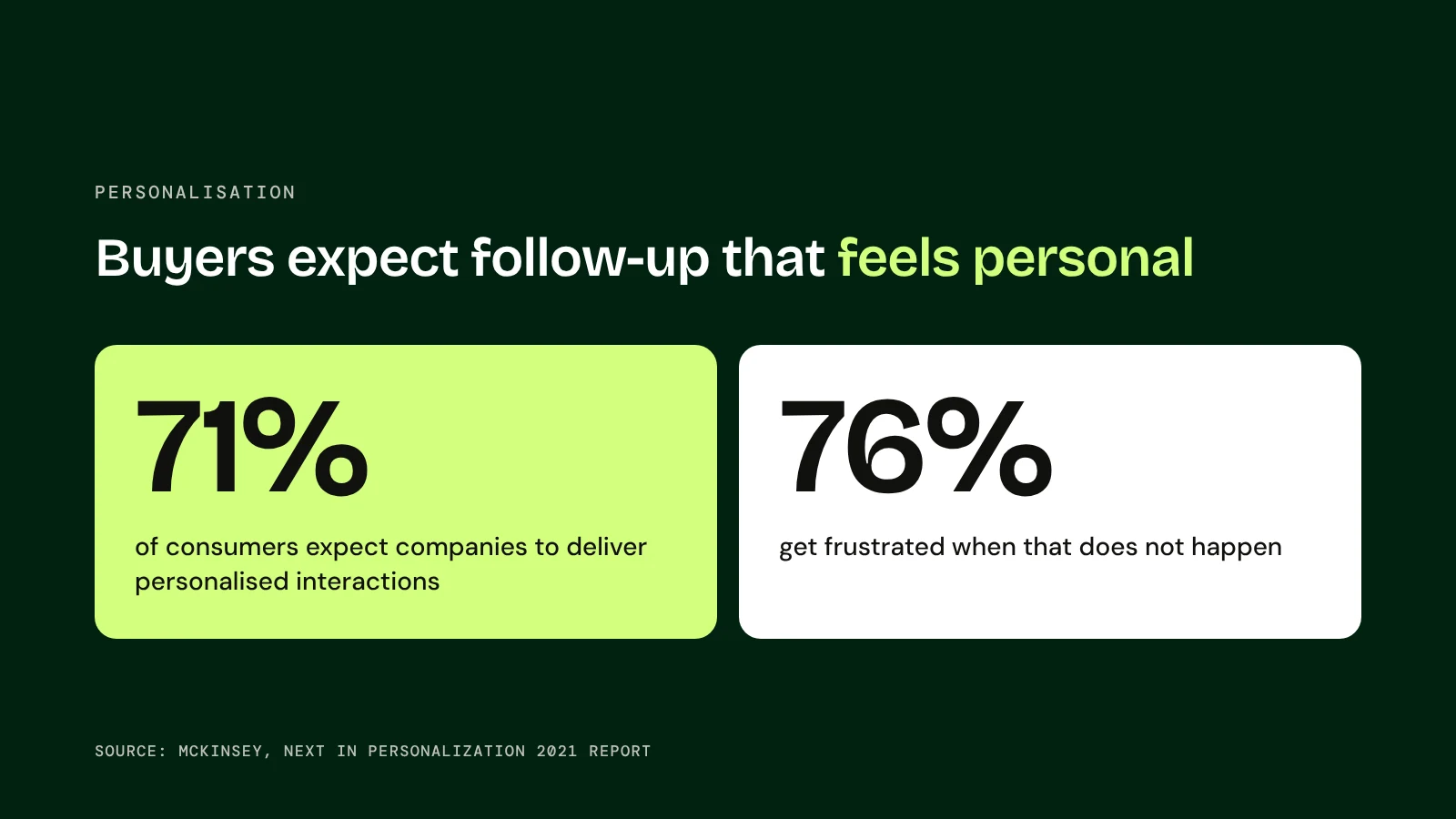
Leads who are not ready to buy are kept warm, because the brands that nurture leads consistently are the ones buyers remember at purchase time. This is lead nurturing done properly: marketing automation delivers relevant follow-ups based on the lead's preferences (model comparisons, offers, financing options, event invitations) to keep potential customers engaged through the customer journey. McKinsey found that 71% of consumers expect personalised interactions, and 76% get frustrated when they do not get them, so generic batch-and-blast emails no longer count as lead nurturing.
6. Measurement
Finally, outcomes flow back. Test drives, showroom visits, and vehicle sales are matched to the original lead and channel, connecting marketing processes to sales outcomes and giving you true conversion metrics per campaign. This closed loop is what lets you shift marketing spend towards the channels producing buyers, not just enquiries. It is where automotive lead management pays for itself.
See how Driftrock manages the full lead lifecycle. Book a demo.
Key features to look for in automotive lead management software
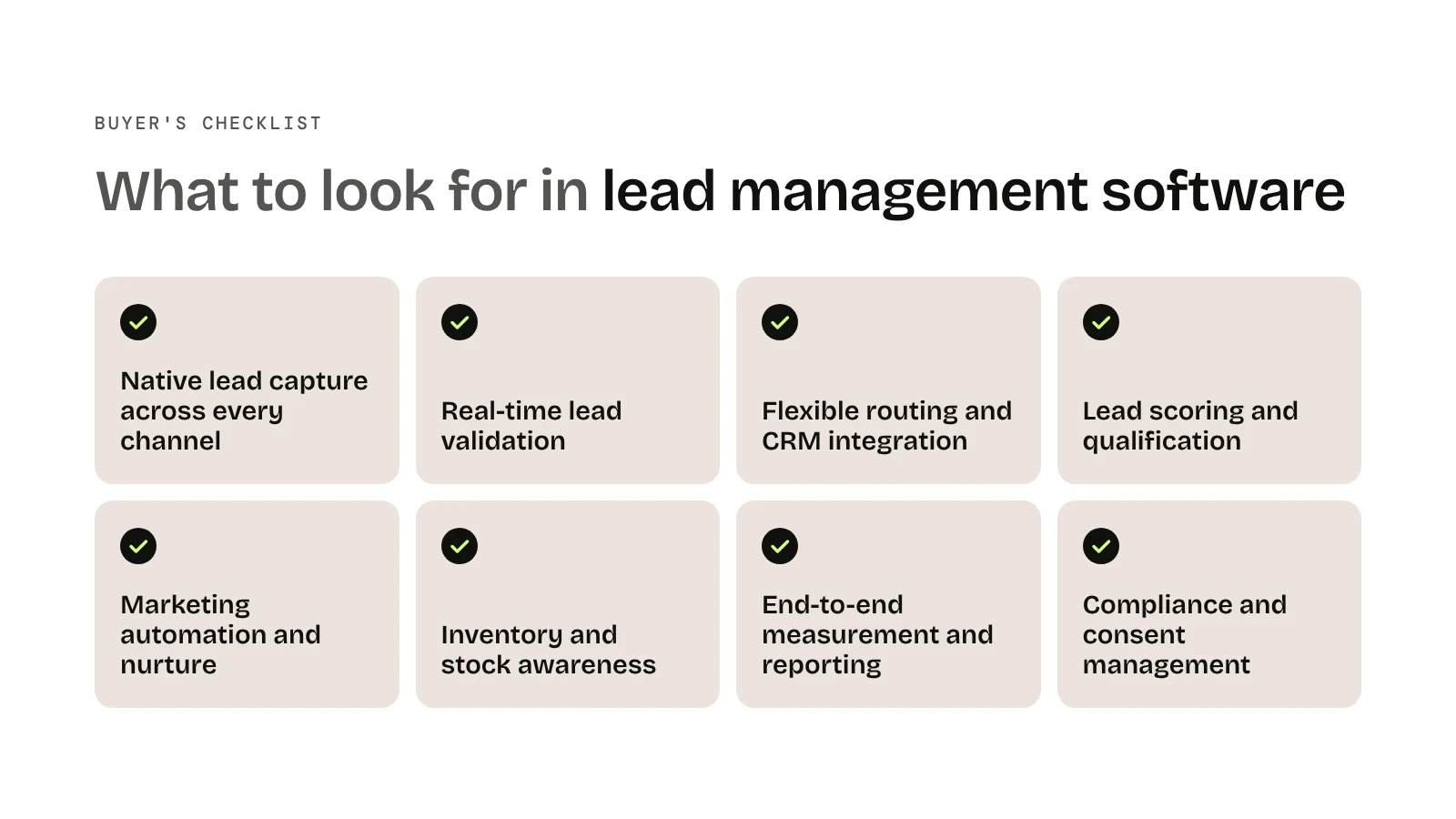
Not every lead management software platform is built for automotive. Rather than re-explaining each capability, treat this section as your evaluation checklist: the questions to put to any vendor when comparing an automotive lead management system.
Native lead capture across every channel
Ask: which sources are native, and which need middleware? The platform should connect directly to Meta, Google, TikTok, LinkedIn, YouTube, your website, and automotive publishers, so new leads flow in real time without manual data entry or CSV uploads. Check what lead information arrives attached: campaign, ad, form, and audience data should carry through with every lead.
Real-time lead validation
Ask: does validation run before CRM delivery, or after? Only the former protects your sales team, and it is the single biggest lever on sales efficiency. Also ask how rejected leads are reported: lead quality should be visible per channel and per lead provider, so you know exactly who is sending junk.
Flexible routing and CRM integration
Ask: will it work with the customer relationship management stack we already run? Whether that is Salesforce, a dealer management system, or a market-specific CRM, the lead management system should slot into your existing sales process, not force a rip-and-replace, so customer interactions stay in sync and integration maintenance costs stay low. Probe routing depth too: can it handle multi-market, multi-dealer complexity with language, geography, brand, and model rules?
Lead scoring and qualification
Ask: how are leads scored, and can we tune the rules ourselves? You want the ability to qualify leads automatically using enrichment data and behaviour, plus AI powered lead scoring that surfaces high quality leads first for sales managers and their teams, so follow up efforts concentrate on the leads most likely to become customers.
Marketing automation and nurture
Ask: what happens to the leads that are not sales-ready? Built-in or integrated marketing automation should nurture leads over months-long buying cycles without manual effort, keeping potential customers engaged and lead nurturing consistent. Good systems also sync CRM segments back to ad platforms, powering lookalike audiences and suppression lists from first-party lead data.
Inventory management and stock awareness
Ask: can it read our stock feed? Automotive-specific platforms connect to inventory management feeds, so follow-ups reference vehicles actually in stock and inventory-led campaigns stay accurate. Generic tools rarely handle inventory management data at all, so probe how it syncs with your DMS.
End-to-end measurement and reporting
Ask: can it prove which campaigns produced vehicle sales, not just enquiries? Reporting capabilities should span the full customer journey: cost per lead, cost per validated lead, lead conversion rates, test drives, and vehicle sales by channel and campaign. Offline conversion syncing back to Meta and Google, using the lead data you already hold, is non-negotiable here.
Compliance and consent management
Ask: where does consent live, and who can see what? Automotive leads carry personal data across borders and between OEMs, NSCs, and dealers. GDPR-compliant consent capture, audit trails, and data retention controls are mandatory, not optional extras.
The benefits of automotive lead management software
What do you actually get for the investment? The benefits of effective lead management show up in four places, from lead conversion rates to dealership operations.
1. Faster response, more conversions
Speed is where automotive lead management pays back first. The MIT and InsideSales.com Lead Response Management study found that leads contacted within five minutes are 21 times more likely to qualify than those contacted after 30 minutes, and with automated routing in a lead management system, new leads reach the right person in seconds by default. In automotive sales, the fastest responder usually wins the customer, whether the enquiry arrives via internet leads or phone calls.
2. Higher lead quality, less wasted effort
Validation and lead qualification mean your sales team works a cleaner pipeline. When OMODA & JAECOO launched in the UK, Driftrock automatically filtered 2,000+ low-quality leads out of 15,000+ generated, saving dealers an estimated 3,557 hours and £66,601 in wasted follow-up effort. That is the practical meaning of lead quality: hours back for relationship building with real buyers, and higher lead conversion rates downstream.
3. Lower cost per sale, better spend decisions
When conversion data flows back to ad platforms, the algorithms optimise towards buyers rather than form fills, and you can compare channels on real outcomes. Renault UK cut cost per lead by 68% by switching to native lead ads managed through Driftrock, and BMW drove a 56% lower cost per lead while boosting lead volume 2.8x. Closed-loop measurement is how you optimise advertising spend with confidence.
4. A better customer experience
From the buyer's side, good lead management means fast responses, relevant messages, and never being asked the same question twice. The brands that use their lead data to personalise customer conversations win trust, and ultimately market share. A smooth customer experience across the whole customer journey also builds the customer relationships that carry into the next purchase cycle.
What is the role of CRM in the automotive industry?
A common point of confusion: if we have a CRM, do we need lead management software?
Customer relationship management systems are the long-term memory of your sales operation. They store customer interactions, purchase history, service records, and pipeline status, and they are where your sales team manages deals day to day. In the automotive industry, the CRM (often paired with a dealer management system) is where customer relationships with the brand live across years of ownership, and where day-to-day relationship building happens.
Lead management software is the front door and the feedback loop. It makes sure that what enters the CRM is real, complete, routed correctly, and fast, and that what happens inside the CRM (test drives, sales) flows back out to your marketing tools and ad platforms.
The two work together. A CRM without lead management fills up with duplicates, invalid records, and leads that arrive too late to win. An automotive lead management system without a CRM has nowhere to send its beautifully validated leads. OEMs and dealerships get the best results when the lead management system integrates natively with the CRM system they already run, which is why no rip-and-replace integration should be high on your evaluation checklist.
How to generate leads in the automotive industry?
Automotive lead management software and lead generation are two halves of the same engine: better lead management makes every source more valuable, because less of what you generate is wasted. The strongest automotive programmes generate leads from a mix of:
- Native lead ads on Meta, Google, TikTok, and YouTube, with pre-filled forms that convert in-market buyers at the point of intent
- Your own website: test drive bookings, brochure downloads, configurator completions, and finance calculators
- Automotive publisher partnerships, reaching in-market car buyers on the sites where they research
- Events and experiential: motor shows, pop-ups, and dealership events
- Remarketing and CRM audiences, re-engaging past enquirers and owners approaching renewal
Whatever the mix, the same rule applies: capture leads from every source into one lead management platform, so lead quality can be compared source by source and budget follows the channels that produce vehicle sales, not just enquiries. If a lead provider sends leads that never convert, you want the data that proves it.
Automotive lead management best practices
Software alone does not fix a broken sales process. These are the proven strategies high-performing brands run on top of their automotive lead management system to sharpen their lead management processes.
1. Cover every hour, not just opening hours. The speed case is already made; the habit is coverage. DAS Technology's 2025 study of 1,700+ dealerships found 61% now respond within 15 minutes, but 19% still take over an hour, usually on the leads that arrive when nobody is watching. Use automated follow-ups (email, SMS, WhatsApp) for initial contact on internet leads that arrive overnight or at weekends, then get a human on the phone first thing. Reserve instant, personal responses for high intent leads, since phone calls remain the highest-converting first touch for serious buyers.
2. Protect dealer trust. Never let unverified leads reach dealers. Nothing erodes dealer confidence in an automotive lead management programme faster than junk leads, and once dealers stop trusting the leads, they stop working them.
3. Agree the scoring rules as a team. Not all leads are equal, but lead scoring only works when marketing and your sales team rank leads by the same criteria: purchase timeframe, model interest, engagement. Agree them together, call the hottest leads first, and let marketing automation nurture leads until they warm up.
4. Match content to funnel stage. Reference the model, the trim, the financing options they asked about, and use the lead's preferences to shape what comes next. Customer testimonials and comparison content work best mid-funnel, when buyers are shortlisting; offers work best once a test drive is booked.
5. Track lead status. Every lead should have a clear owner and stage. Shared visibility across marketing and sales stops leads dying in handover gaps, and gives sales managers real team performance data instead of anecdotes.
6. Make sales matching a routine. Measurement only works if the data stays current. Reconcile sales against leads weekly, not quarterly, so conversion rates by channel are fresh when budget decisions get made. The habit compounds: better optimisation data means better leads generated, quarter after quarter.
7. Mine your existing base. Owners approaching finance renewal, service customers, and lapsed enquirers are some of the highest-converting audiences you have. Purchase history is a lead generation asset; use it.
How Driftrock approaches automotive lead management
Driftrock is the automotive customer acquisition platform built for the full lead lifecycle: capture, validate, convert, measure. We work with automotive OEMs, national sales companies, dealer groups, and their agencies, processing over 2 million automotive leads a year across 32 markets for 35+ brands.
Here is how the platform maps to everything covered in this guide:
- Capture: native integrations with 40+ lead sources including Meta, Google, TikTok, YouTube, and a network of automotive publishers, so every lead flows into one place in real time
- Validate: automatic email, phone, and duplicate validation that rejects invalid leads (typically around 10%) before they ever reach your CRM or dealers
- Convert: routing, qualification, and nurture tools that get the right lead to the right dealer sales team fast, and keep the rest warm until they are ready
- Measure: end-to-end tracking from first click to vehicle sale, with offline conversions synced back to ad platforms so your campaigns optimise towards buyers
The results from live campaigns speak for themselves: Renault UK cut cost per lead by 68% in five days, BMW achieved a 56% lower cost per lead while growing lead volume 2.8x, and OMODA & JAECOO generated 15,000+ validated leads across 9 channels to power one of the fastest UK market entries in automotive history.
And because Driftrock integrates with the CRM and dealer systems you already use, teams are live in weeks, not months, with no rip-and-replace.
Talk to an Automotive Expert today
Frequently asked questions
What is automotive lead management software?
Lead management software captures leads from your marketing channels, validates and qualifies them, routes them to sales, nurtures them until they are ready to buy, and measures which campaigns produce customers. It sits between your marketing tools and your CRM, making sure no lead is lost, duplicated, or left waiting.
What is the automotive lead management process?
The automotive lead management process runs through six stages: capture, validation, qualification and scoring, routing, nurturing, and measurement. Each stage moves a lead closer to purchase while filtering out those who will never buy.
What are the stages of an automotive lead?
A typical automotive lead moves from new (just captured), to validated (contact details confirmed), to qualified (matches your buyer criteria), to engaged (in active conversation or nurture), to opportunity (test drive booked or offer requested), and finally to converted or closed. Clear lead status definitions in your lead management system keep marketing and sales aligned on where every prospect stands.
Which tool is commonly used for automotive lead management?
Most businesses use a combination of a CRM system for pipeline management and a specialist lead management system for capture, validation, routing, and measurement. In automotive, dedicated auto lead management platforms like Driftrock handle the automotive-specific requirements: dealer routing, publisher integrations, inventory-aware campaigns, and offline sales matching, feeding validated leads into whichever CRM the brand runs.
What are the benefits of automotive lead management?
The main benefits are faster lead response time, higher lead quality reaching sales, higher lead conversion rates, lower cost per sale through better spend allocation, and a better customer experience. Lead management also gives leadership accurate visibility of the sales pipeline, which marketing campaigns produce customers, and true marketing ROI.
What is the best automotive lead management software?
The right automotive lead management system depends on your setup: OEMs and multi-market brands need deep dealer routing, publisher networks, and enterprise compliance, while single-site dealerships may prioritise simplicity, DMS integration, and fit with existing dealership operations. Evaluate against the feature checklist in this guide, and weight native channel integrations, validation, and closed-loop measurement most heavily, because they drive the largest gains in conversion rates. The best automotive lead management software combines all three. Driftrock is built specifically for automotive OEMs, national brands, and their agencies managing the full lead lifecycle.
Conclusion
Automotive lead management software is no longer a nice-to-have. Buyers research online, enquire with multiple brands, and reward whoever responds first with their business. The brands winning today are not necessarily generating more leads; they are converting more of the leads they already have, by capturing them cleanly, validating them instantly, routing them in minutes, and measuring all the way to the vehicle sale. Effective lead management is how they do it.
The question is not whether you can afford to invest in lead management. It is how many sales you are losing every month without it.
More vehicle sales, from every lead you generate.