
.svg)
Car buyers do not shop in one place. The average UK buyer compares listings across four car search sites, up from 3.5 in 2021, over a journey of about 48 days from first search to purchase (MOTORS Digital Touchpoints Survey 2025).
The pattern holds across Europe. In Germany, 41.9% of buyers researched on specialist automotive apps, 40.4% on manufacturer websites and 35% on dealer or retailer websites. In Italy, Spain and France, around two thirds (66% to 68%) also visited a dealership along the way (Codeweavers).
Car brands, on the whole, still market in one. We analysed 2.1 million leads captured for OEM and national sales company accounts (across 29 markets, from September 2025 to August 2026). Nearly half of brands run just one channel at scale. For the typical brand, 93 in every 100 leads come from a single source.
The usual explanation is quality: new channels mean worse leads. Our data says otherwise. Wrong details are rare on every channel, and verification rates sit within a few points of each other across the channels we measured. So the real cost of a one-channel strategy is not lead quality. It is the buyers you never meet.
Buyers shop everywhere. Most brands show up in one place.
Meta lead ads are the industry default, and they have earned it. They deliver more OEM leads than other channels, they verify well, and they reach buyers in the evenings, when other channels are quiet. There is even diversity inside the channel: Instagram delivers one in three Meta leads, and its leads verify exactly as well as Facebook's. Brands that treat Meta as one thing are already reaching two audiences.
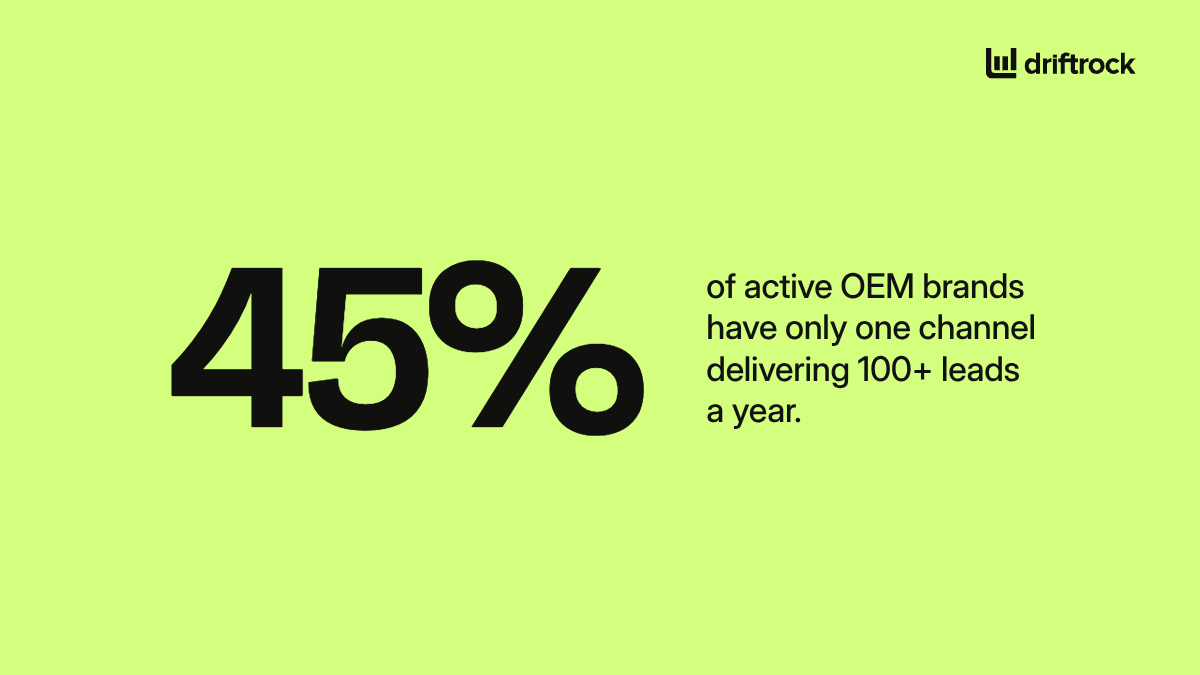
The rest of the market arrives through five other routes, and most brands have not tested them at scale. 45% of active OEM brands in our data have only one channel delivering 100 or more leads a year. That is a lot of brands meeting a seven week, four site journey at a single point.
The gap is widening, not closing. Comparing the same brands a year apart, lead volume grew 46%, but the mix became more concentrated. Most of that growth landed in the channel brands already relied on.
The largest brands are the exception. Single-channel brands account for just 4% of OEM lead volume: the biggest players already run broader mixes. For smaller brands and newer market entrants, the gap is an opportunity rather than a verdict.
Quality is not the reason to wait
The most common case against adding a channel is quality. Across 2.1 million validated leads, that fear simply does not show up.
- Wrong details are rare everywhere: Only 1 to 5% of leads fail validation, on any channel.
- Five channels verify alike: Google 90%, publishers and affiliates 89%, TikTok 89%, Meta 87%, owned web and events 86%, with both email and phone confirmed.
- More channels, same quality: Brands running two or more channels verify 82% of leads. Single-channel brands verify 83%.
Verified means both email and phone confirmed. Most of the remainder is missing or unconfirmed detail, not wrong detail: marketplace enquiries, for example, usually arrive with one contact route.
If quality is equal, the question changes. It is no longer "is this channel good enough?" It is "what are we missing without it?"
What one channel misses: coverage
The hours of the week
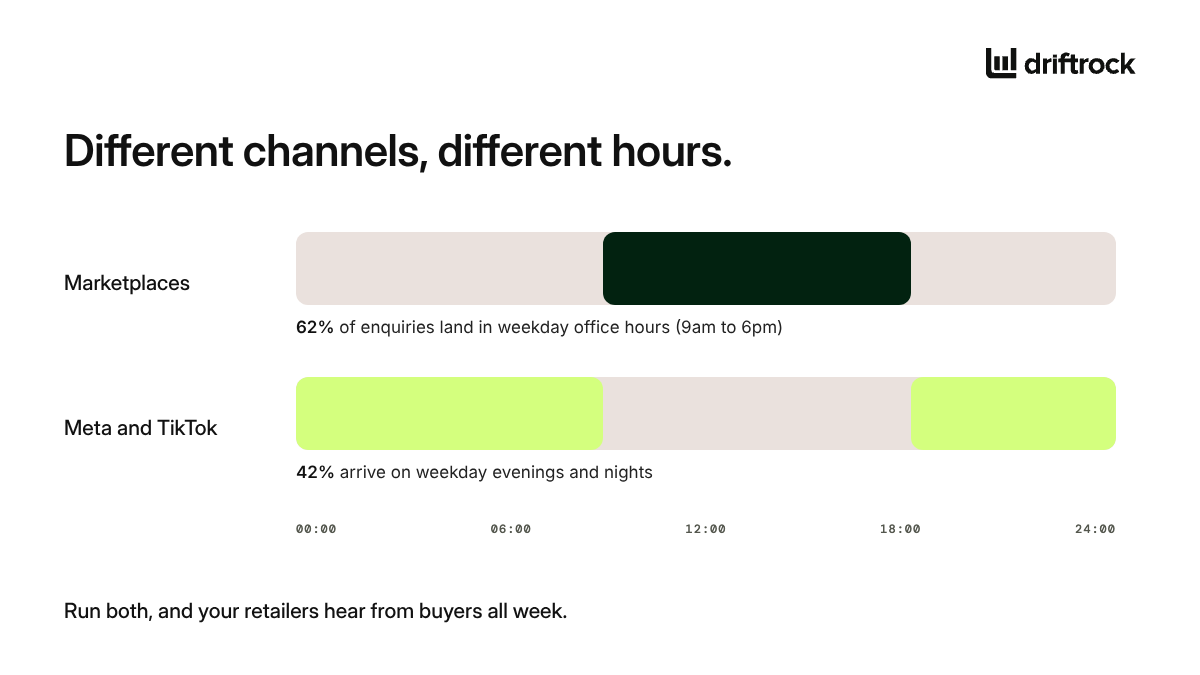
In the UK, six in ten marketplace enquiries land in weekday office hours (9am to 6pm). 42% of Meta and TikTok leads arrive on weekday evenings and nights. A brand on one channel hands its retailers buyers on one schedule. Run both, and enquiries arrive across the whole week.
The moment buyers compare
Those four car search sites are where buyers line up models side by side. Marketplaces put your brand in that moment, and they are growing: among the same brands year on year, marketplaces gained share of the mix.
The demand you already create
Channels feed each other. Analytic Partners' ROI Genome, drawing on 700+ brands in more than 45 countries, finds that TV and online combined drive a 25 to 30% higher ROI than online run on its own (Analytic Partners via WARC). Some of the demand you build in one channel surfaces in another. Being there lets you capture more of what your marketing already generates.
Where to start
- Keep your strongest channel working: Diversity is additive. Build around it, do not replace it.
- Find your biggest gap: Look at when your leads arrive and where your buyers compare. Heavy on evening social? Daytime marketplace demand is the natural next step.
- Add one channel and hold it to the same standard: Validate every lead the same way, so you compare channels on facts, not assumptions.
- Judge the mix, not the channel: Channels influence each other, so measure how they perform together.
The bottom line
Channel diversity is not a quality trade-off. In our data, lead quality holds up across channels. It is a coverage decision: more of the week, more of the journey and more of the demand you already create.
Your buyers are comparing four sites over seven weeks. How much of that journey is your brand part of?